Who's actually on the other end of that scam call
There's a whole genre of videos where people string scammers along for laughs. It's satisfying — someone tried to steal from strangers and got wasted time in return. It's worth knowing something about who is often holding the phone on the other side.
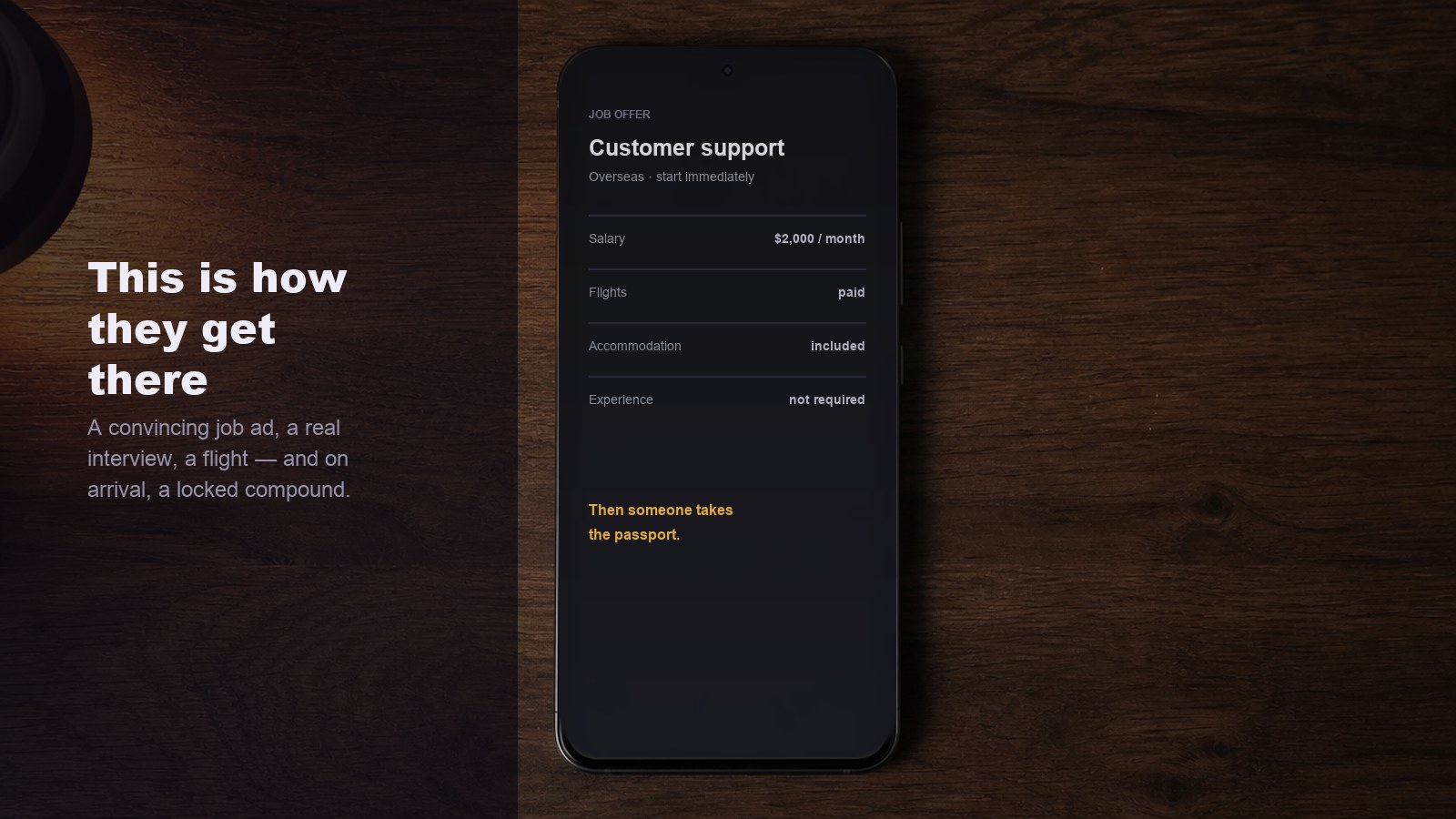
It starts with a job ad. Customer support, another country, around two thousand dollars a month, flights and accommodation paid, no experience required. There's a real-looking interview and a real flight. On arrival, someone takes the passport, and the job turns out to be running scam scripts inside a locked compound, with a daily target. People who try to leave are told they owe a debt for their own transport.
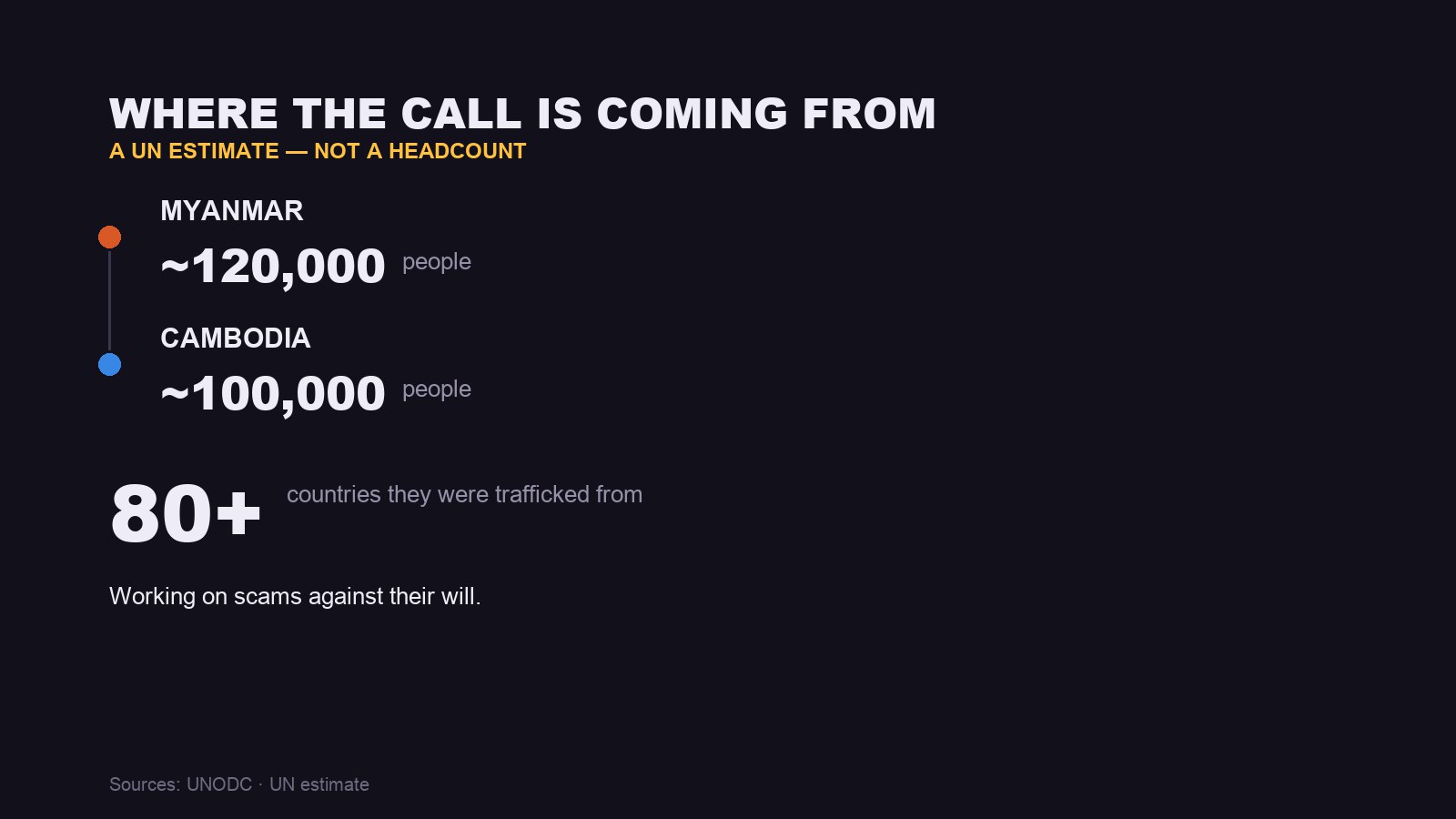
The scale is hard to take in. UN-cited estimates put roughly 120,000 people in Myanmar and 100,000 in Cambodia in conditions of forced criminal labour, with victims drawn from more than 80 nationalities — an estimate, not a headcount. When Myanmar's military raided the KK Park complex in October 2025, more than 2,000 people were detained and around 1,500 fled across the border into Thailand; SpaceX remotely disabled over 2,500 Starlink terminals that had been keeping the compounds online. Eight months later, a rights group reported more than 5,300 people still held.
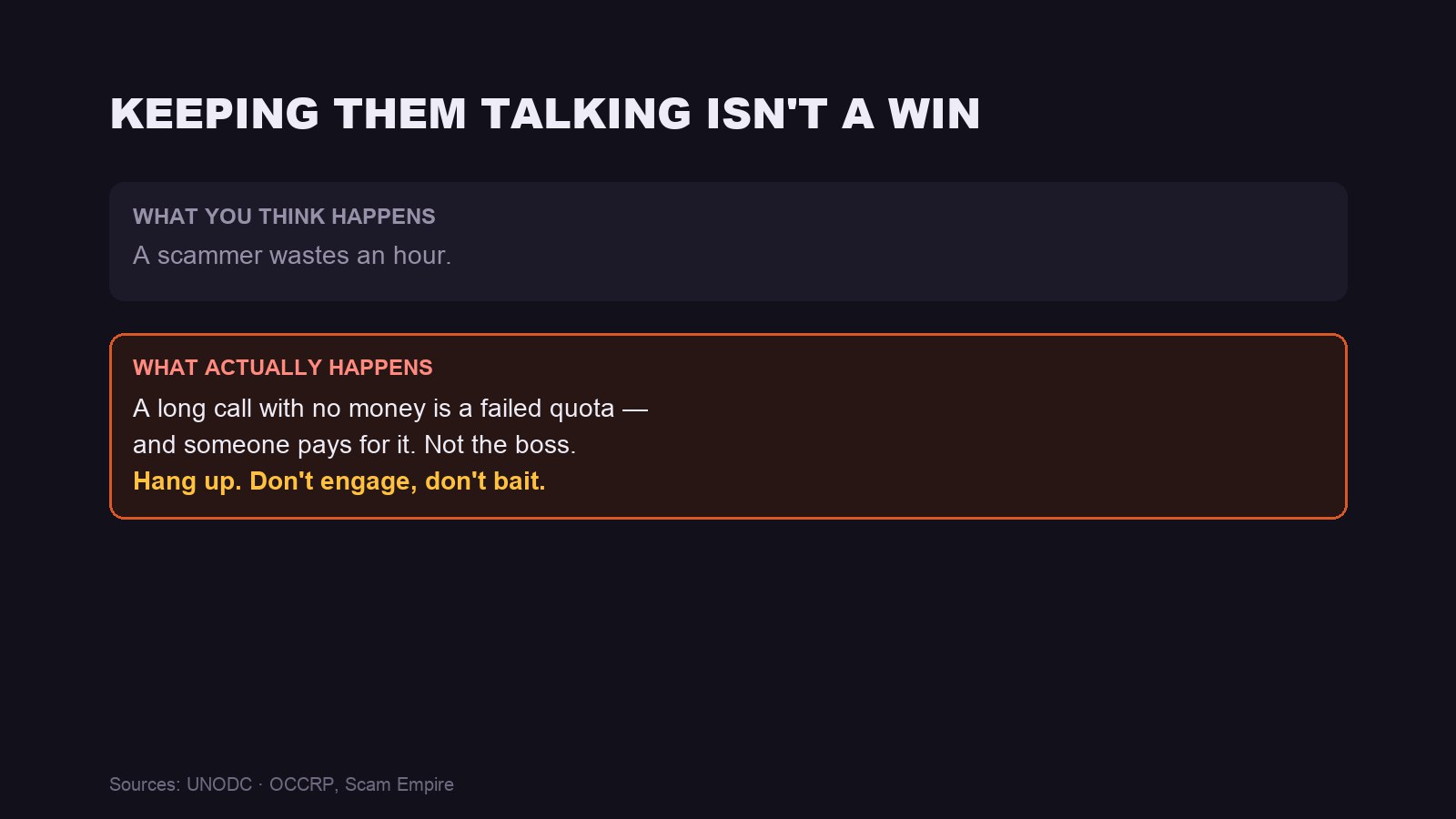
Here's the part that should change how you hang up. You've probably heard that wasting a scammer's time is a small victory. In these operations it isn't. Engagement is the metric the quota is measured in, so a long call that extracts no money is a failed target — and the person who pays for that is the one on the phone, not the person who owns the compound. Scam-baiting for content aims at the last and least powerful link in the chain.
None of this changes what you should do on the call: hang up, send nothing, and don't stay on the line out of sympathy — "I'm being forced to do this" is itself a documented manipulation script, and you cannot verify anyone's situation over the phone. What it changes is who you picture on the other end. The most useful thing is to make the call fail cheaply, and better still to stop it ringing at all: Block-Spam checks incoming calls against a community-reported spam database held on your device, so numbers other people have already flagged never reach you. Free on iOS and Android. Sources: UNODC, "A global wake-up call to organized fraud" (unodc.org); Al Jazeera on the KK Park raid and on the 5,300 still held (aljazeera.com); CNN on the disabled Starlink terminals (cnn.com); OCCRP, "Scam Empire" (occrp.org); US Department of Justice, Prince Group indictment (justice.gov).
Protect yourself today
Download Block-Spam and stop spam calls with AI-powered protection — free for iOS and Android.